Not ‘Just a Gate…’
One could mistake the James Houison-designed 1856 gate serving as the single (authorised) entry point into the historic St. John’s Cemetery, Parramatta, as being merely a mundane, utilitarian, man-made wooden structure. Those more au fait with architectural history might argue that, actually, this particular gate adds a touch of Olde English charm to the burial ground by visually and architecturally connecting it to so many of its much older counterparts, still silently guarding the entry to English churchyards a hemisphere away.[1] Neither view, however, would be entirely satisfactory, because both views obscure the folklore—some might call it ‘superstition’—that these gates are a great deal more.

A Cosmic Boundary
Even on its most profane level, a gate is a threshold; a physical demarcation between one space and another that paradoxically connects the very space it severs.[2] A gate is, therefore, a ‘liminal space,’ but rather than its spatial properties it is its liminality that constitutes its most significant feature; for, as Hebrew Language and Literature scholar Daniel A. Frese notes, liminality is both a property of space and time, and to this I would also add it is a property of states of being.[3]
From time immemorial, people in cultures all over the world have recognised paradoxical, transitional ‘liminal’ spaces, periods and even experiences, such as altered states of consciousness, as spiritually powerful and profoundly sacred—yet, they have also understood them to be equally unstable and, thus, fraught with immense danger.[4] As anthropologist Mary Douglas explains, ‘Danger lies in transitional states, simply because transition is neither one state nor the next, it is undefinable.’[5] In this neutral ‘no-man’s land,’ this place, time or state of ‘in-betweenity,’ the individual is in transition ‘from one existential situation to another’[6] and ‘is himself in danger and emanates danger to others,’[7] for in this liminal state and time of chaos the status quo is entirely obliterated by extreme emotion and the uncertainty of inevitable changes within the social structure. The only means of gaining some semblance of control over the danger,[8] to safely channel these dangerous emotions, navigate through the shifting power dynamics, and ultimately come out the other side and restore order, is by following the tried and true customs of ritual.[9]
For the Irish, including the likes of Fanny and Simon Burn who came as convicts and began new lives for themselves in North Parramatta, this transitional zone was accessed and experienced sonically, most notably in the cries of the bean chaointe (keening woman).[10] Her extreme grief took her to the limits of the profane world, to the threshold between the lands of the living and the dead, where she sang mournful lamentations over the dead body and thus guided both the departed one’s soul on its journey to the ever after as well as the community of survivors in their own journey through the equally transformative grieving process.[11] But for fellow mourners, the only indication that the keening woman was indeed at this cosmic threshold or gateway was her extraordinary visual and sonic performance.[12]
For others, a visible and tangible manifestation of the spiritual ‘paradoxical’ zone itself was required in the form of an actual gate.
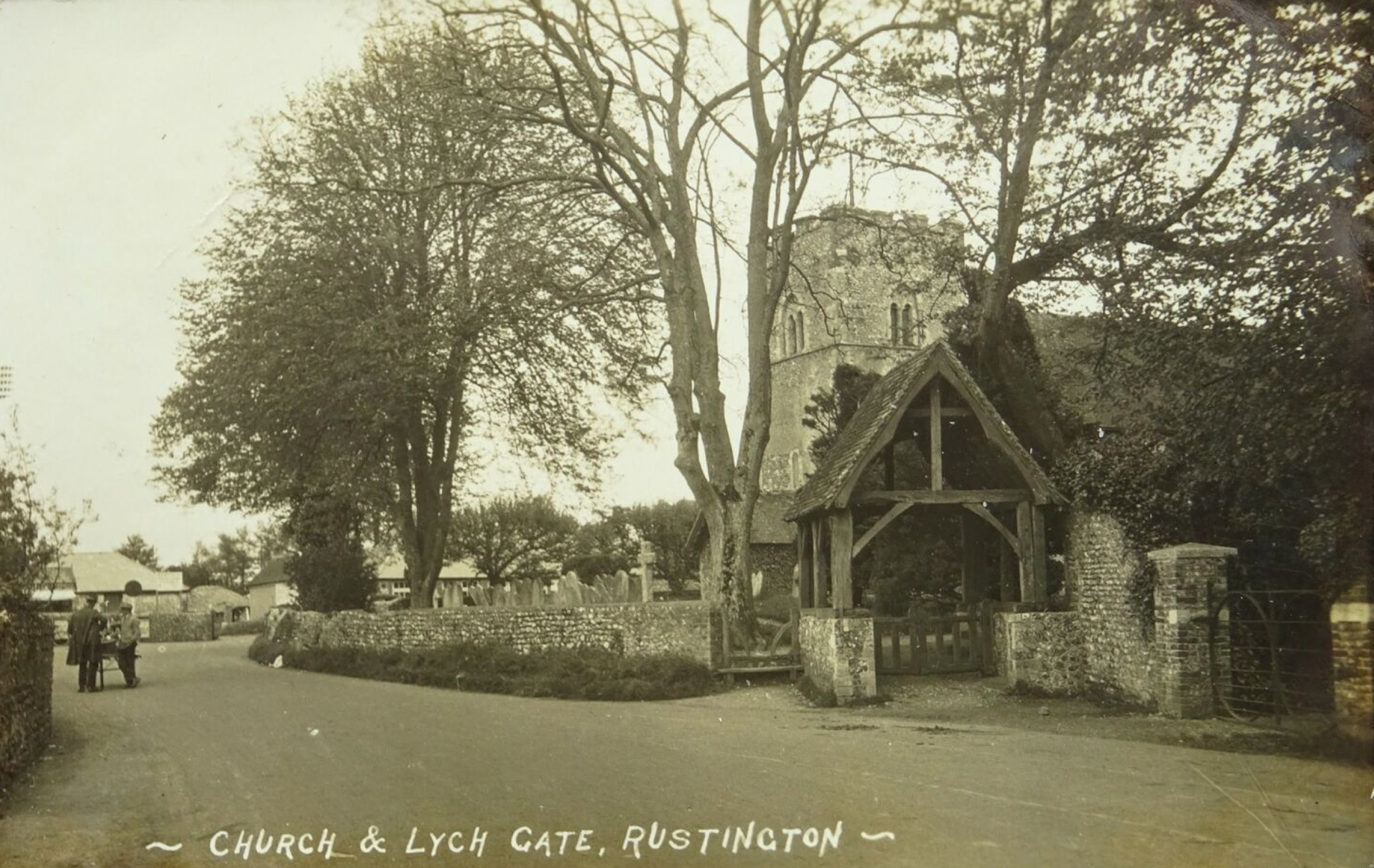
The Gate of the Dead
The precise name for the gate welcoming visitors to St. John’s Cemetery is a lychgate (also spelt lichgate), from the Saxon lic/h meaning ‘dead body.’[13] The Saxon word, which appears in other outdated funereal terms, including ‘lic-rest’ (a body-rest),‘lic-man’ (a man who provides for funerals), and ‘lych bell’ (the ‘lytell…bell that went before the corps [sic]’ and was rung as the funeral procession approached the church),[14] has long since been superseded by the Romance word corpse, although a descendant of the even older East-Germanic ‘Gothic’ word leik survives in modern German (leiche: corpse).[15] This architectural feature of the cemetery is literally, therefore, ‘the corpse-gate’ or ‘the gate of the dead.’[16]
Traditionally, such ‘corpse-gates’ served a practical purpose during funeral proceedings. Their ‘broad outspreading gable roof’ provided both shelter to mourners and a ceremonial space ‘where the bearers of the dead might deposit their burden, and rest awhile’[17] until the minister officiating the funeral met them there in accordance with the ‘rubric’ of The Book of Common Prayer (1549), and commenced the burial service.[18] For this reason, some lychgates included benches (lychseats) for mourners to be seated and some even featured ‘a long flat slab’ ‘of about a coffin’s length’ known as the lychstone, where the body could be placed during these initial proceedings.[19] At St. John’s Cemetery, Parramatta, we find neither lychseats nor the raised slab known as a lychstone within its lychgate.
Notwithstanding the practical benefits of the lychgate, traditionally these structures also possessed a deeply spiritual function. The deceased person’s physical movement through the corpse gate during the funeral proceedings replicated the state of spiritual transition they were believed to be in the process of experiencing, ‘cross[ing] the threshold of this mundane sphere,’ having left the community of the living without having been accepted yet into the community of the dead.[20] In short, like the gate that simultaneously connects the space it severs, at this stage the deceased was physically severed from the mourners yet still connected to them, because he or she was not socially dead. The difference between the two states of physical and social death can be no better exemplified than in the recent lying-in-state of Her Late Majesty Queen Elizabeth II: as one commentator observed as thousands filed past the catafalque, it was as though the public was clinging to every last second of her reign and, for another reporter, The Queen herself was ‘still on duty.’[21] Both statements were by no means mere hyperbole; all witnessed the exceptionally prolonged suspension of The Queen’s social death until the Crown, orb and sceptre were ceremoniously removed from her coffin one by one, even though, in the interests of avoiding the instability of another transitional state or liminal period—interregnum—Charles III’s sovereign reign had already commenced immediately upon the last breath of Elizabeth II.[22]

In passing through such architecturally-defined portals to formal cemeteries, living mourners and cemetery visitors in general may also undergo a transitional experience. They leave the profane world outside and stand on the precipice of becoming immersed in a palpably distinct world within, where they might even feel compelled to alter their behaviour. For instance, some with ancestral ties to St. John’s Cemetery still publicly aver that they would never walk over or sit on a marked grave. However, a diversity of beliefs and customs exists among the living now, just as it did amongst those who were interred in what was originally the general cemetery for all religious denominations: accordingly, it is still very much a case of ‘each to their own,’ as opposed to the imposition of a single way of being upon all and sundry. To those who do continue to subscribe to any or all of the traditional British mortuary beliefs and customs, though, as landscape architect and acoustic consultant Per Hedfors asserts, ‘by creating a tangible contrast’ between the sights and sounds of the mundane world outside, the lychgate specifically has the ability to ‘command a dignified behaviour’ within, such as speaking in reverent, hushed tones to suit the solemnity of the clearly demarcated cemetery setting.[23]
The Gatekeepers
Effectively, the English officiating minister beneath the lychgate, the Irish bean chaointe (keening woman), and others performing similar funerary functions in different cultural contexts, served as living gatekeepers between what was conceived of as the corporeal and spiritual realms. Yet tradition has it that they were not the only ones who fulfilled a gatekeeping role.
According to folklore, ‘the spirit of the last person’ buried was obliged to stand guard at the lychgate, watching over the grounds, till the next person was interred and came to relieve them of their duty.[24] ‘Serious consequences have resulted from this notion,’ wrote T. F. Thiselton Dyer; for instance, ‘terrific fights have taken place at the entrance of the churchyard, to decide which corpse should be buried first.’[25] Dyer states that such scenes were also common in Scotland. In ‘certain parts of the county of Argyll,’ noted Sir John Sinclair in his Statistical Account of Scotland, ‘when two burials were to take place in one churchyard on the same day, a singular sight occurred: “Both parties staggered forth as fast as possible to consign their respective friend in the first place to the dust; if they met at the gate, the dead were thrown down till the living decided by blows whose ghost should be condemned to porter it.”’[26]
Unlike those who saw the gatekeeper role as a burden on the dead, Parramatta’s chief gravedigger, Sam Cook, happily served as a living version of the spirit at the gate for decades. Not only did Sam dig St. John’s graves for some sixty years till shortly before his death in 1925, he also kept a ‘wistful’ watch o’er its lychgate from the verandah of his own abode, conveniently situated across the road from the cemetery. And as he entered the lychgate, he did so ‘softly so that, as he explained [to a visiting reporter] in a gentle whisper, he would not wake his sleeping family.’[27] Although illiterate, Sam Cook ‘could, at a moment’s notice, locate any one of the thousands of graves, which he had at some period or other filled in.’[28]
At one time, he had kept a book for the purpose of recording the interments, and this was regularly attended to by a friend, until there was no longer space for names. With the ravages of time, its condition became sadly impaired, but if an inquirer wished to know where a certain person had been interred, say thirty years ago, Sam could turn to the correct page, despite the inscriptions thereon might have been Chinese for aught he knew to the contrary. His memory for incidents in his work was wonderful, and he could recall the details of burials of half a century back as though the ceremony had been performed yesterday.[29]
Even when illness ‘forced [Sam Cook] to relinquish active operations’ and left his ‘pick and shovel…idle,’ ‘wet or fine he was to be found among his familiar tombstones. The cemetery was his domain, and until he became too weak to venture forth, he regularly trod the well-worn paths.’[30]

Faux Antiquity
Deeply rooted as these lychgates are in British culture and architectural history, we must bear in mind that, as far as we know, the ‘Old Parramatta Burial Ground’ established c. January 1790 and later renamed St. John’s Cemetery, was not enclosed in any manner whatsoever until late 1811. It was in 1811 that a long list of Old Parramattans (including the author’s ancestor, Thomas Barber) raised £82, 4s, 7d in compliance with Governor Macquarie’s May 1811 order that all burial grounds be ‘speedily inclosed in a decent manner…either by a good Wall or strong Pallisadoes…to protect the Remains of their Deceased Friends from every unnecessary Exposure,’ such as wandering stock.[31] Even then, it seems only a ditch and fence were to be covered by these funds. There was no explicit mention of any gate being added to the public burial ground in what was still the rough and ready penal colony in 1811, so we can only assume that the more elaborate design of a sheltered lychgate was not a feature of the earliest burials conducted at the burial ground. These 1811 additions of a ditch and fence did little to prevent ‘the entering of cattle, dogs, pigs, etc, etc,’ and ‘every’ other species of ‘foot inclined to enter’[32] so, much to the chagrin of ‘Philomath,’ the burial ground could still be described as being ‘altogether unprotected’ as late as December 1824.[33]

Thus, it was not until the mid-1820s, during Brisbane’s governorship, that the slow construction of the more substantial, convict-built sandstock brick wall commenced at the cemetery.[34] Presumably, some sort of entry gates and, most likely, the sandstone flagstones immediately within the entrance were also a part of this 1820s development, since repairs to these ‘gates’ were specifically ordered in 1855—a year before Houison was commissioned to design and erect the 1856 lychgate at the cemetery.[35] What form those early pre-1856 gates took—that is, whether they stylistically referenced the lychgates of the British Isles—is unknown, as there is no recorded description of them.
Even the wooden component of the lychgate currently gracing the entrance to St. John’s Cemetery is not original to 1856, owing to the limited life of wooden building materials exposed to the elements. It is, however, a faithful replica of Houison’s entire 1856 design, which was executed in 1982 with the assistance of the Parramatta Rotary Club. More recently, in 2016, with funds raised by local group the Friends of St. John’s Cemetery, the Hills Men’s Shed reconstructed the 1982 wooden gates, which had begun to show some signs of deterioration in the intervening years.
The majority of the thousands of burials that took place within St. John’s Cemetery grounds since c. January 1790, therefore, took place without the practical and spiritual benefits of a lychgate at its entrance. While Houison’s 1856 lychgate design is not a remnant of the original Georgian-era cemetery, though, it is evidence of a conscious decision to adhere to a timeworn British funerary tradition. In the process of producing and implementing his design, Houison channelled all the aged European folklore embedded within such a structure, doing his part to visually and spiritually colonise the Burramatta landscape by lending it the faux-antiquity of an early modern English architectural item in what was then still only a 68-year-old colony.
But what might St. John’s lychgate signify for Parramattans—and Australians more broadly— today?
A Portal to the Past
For those visiting St. John’s Cemetery, Parramatta in the present day, the majority may no longer subscribe to the British folk belief that the last person buried still invisibly stands guard at the lychgate, and few would consider the colonial imposition of British cultural artefacts on Burramattagal Country to be unproblematic. Nevertheless, even for the most secular visitors, it ought to be plain that this is not just a gate. In passing through this gateway, we physically leave the bustling metropolis of modern Parramatta behind us, and find ourselves transported and immersed in the quieter, multilayered past world of ‘Old Parramatta’—from the native grass that once covered all of pre-contact Burramattagal Nura (Country) and is preserved therein, to the stone memorials and actual corporeal remains of the ‘Old Parramattans’ themselves who now comprise a ‘little city of the dead.’[36]
Burramattagal Nura (Country)
For thousands of years, the land on which St. John’s Cemetery, Parramatta is located has been the Nura (Country) of the Burramattagal People. As the placename Burramatta ‘place where eels lie down’ indicates, Parramatta is where the Burramattagal fished, hunted and gathered their life-sustaining resources in abundance without depleting the land. They did so, thanks to traditional land management practices, namely firestick burning, which allowed their Nura to flourish into what appeared to the newcomers’ eyes as ‘a great Extent of Park-like Country,’ with rich, fertile ‘Soil…apparently fitted to produce any kind of Grain, and clothed with extraordinarily luxuriant Grass.’[37]
This ‘luxuriant Grass,’ which was formerly seen all over Burramattagal Country and featured in many an early landscape painting of the region, including Joseph Lycett’s series of Parramatta Views, was among the ‘Long, blady grass’ that ‘seemed to be vieing [sic: vying] with the ugliest weeds to hide forever from man’s sight the resting places of the dead,’ when a Sunday Times reporter named W. A. Carrick visited St. John’s Cemetery in 1923.[38] And it is the same native grass that can still be found in the cemetery today whenever another relentless La Niña downpour or other impediment to the established regular maintenance schedule assists Nature in her own ceaseless task—ever-striving to swallow up death.
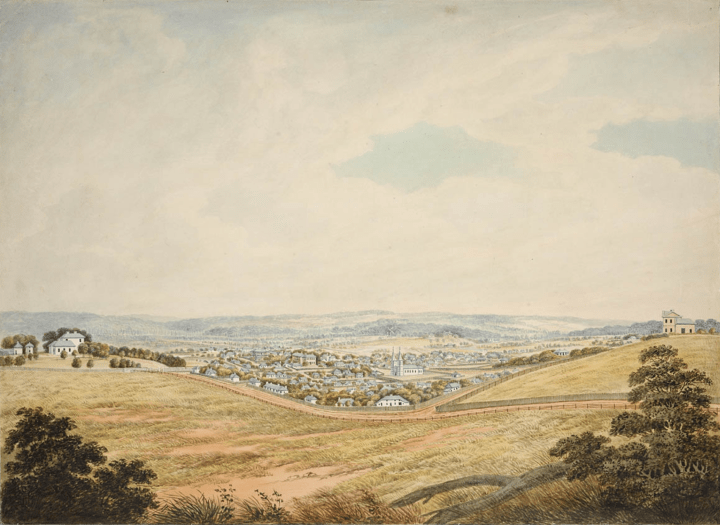
For the 1920s reporter W. A. Carrick, the sight of long grass, ‘ugly weeds,’ and green moss growing ‘wild’ over St. John’s European headstones appeared to ‘desecrate the memory of the dead,’ just as it does now for many who may happen upon the cemetery when it is inhospitably rugged. Over the past seven years, there have been favourable stretches of time when the cemetery’s inclusion on the New South Wales Corrective Services’ regular three-week mowing schedule resulted in the cemetery being so well maintained that at times it resembled a billiard table, with not a single millimetre of the site inaccessible to anyone wishing to tiptoe through its 700+ extant tombstones. However, the unforgiving sequence of unfortunate events, beginning with air-polluting bushfires, La Niña weather events, and a global pandemic, wholly thwarted the previously regular mowing schedule and working bees of local volunteers that, hitherto, had nipped in the bud the growth of the infamous lantana and blackberries, among others. In the interests of neighbouring property rights, accessibility, safety, keeping financial costs of professional clearing to a minimum and, of course, the conservation of the site’s highly valuable and irreplaceable built heritage features—particularly its currently significantly compromised convict-built sandstock wall—the private property owners of the cemetery and surrounding properties cannot allow such overgrowth to get out of hand.
Yet it is also worth bearing in mind that the site’s inhospitality at times is purely from an anthropocentric perspective. In such a state it is inhospitable to human visitors, but the same conditions render the cemetery a welcoming haven for wildlife, such as the white-faced heron observed roaming the grounds recently.[39]
Indeed, the cemetery’s biodiversity is just as much a valid part of the heritage we must endeavour to protect, for environmental as well as social and cultural reasons. Ignoring the biodiversity heritage of the site amounts to a Eurocentric, environmentally-unfriendly management practice in which the European built elements of the cemetery are protected at the total expense of the indigenous natural elements via European mowing practices and the use of harmful chemicals.
As we cast our eye internationally, we find recent examples of the adoption of ‘rewilding’ management strategies that have successfully reduced maintenance costs and the use of poisons whilst counteracting the urban heat island effect and even improving psychological wellbeing in the broader (human) community. (See, for example, the King’s College, London lawn that transformed into a wildflower meadow following a suspension of mowing practices).[40] A ‘rewilding’ of St. John’s Cemetery naturally occurred on site during COVID lockdowns when regular mowing was unexpectedly forced to cease, as captured by Instagrammer, @ecocentric_ on 30 May 2020, when those Lycettian fields of Burramattagal Country emerged amid the modern Parramatta cityscape once more.
Unfortunately, as previously noted, the native grasses were not all that flourished in that unplanned ‘rewilding’ period. Dense lantana, in particular, has gotten so out of hand over the southern boundary wall especially, nothing but significant professional clearing will address the problem. The same invasive weed is likely overwhelming and choking more than the cemetery’s walls, because lantana is known to reduce a site’s biodiversity by outcompeting and suppressing native species.
Ideally, in the future the site will be managed in such a way that the reportedly native microlaena stipoides (‘Weeping Grass’) and themeda triandra (‘Kangaroo Grass’) will coexist with the material remains of the European cemetery: but how?
A less Eurocentric, less expensive, less laborious, more eco-friendly and more efficacious, long-term solution to the site’s management is required. Fortunately, there has been a potential solution floating around for years, thanks to a local, self-confessed ‘dendrophile’ named Simon Alexander Cook. Cook has been ahead of his time in advocating for an ‘urban shepherd tourism’ program at St. John’s Cemetery utilising goats since before the Friends of St. John’s Cemetery even formed in late June 2016. What makes Cook’s idea appear to be such a viable option is that the goats nibble at many weeds (a full list of weeds palatable to goats can be accessed here) whilst leaving native grasses, thus encouraging native revegetation, as demonstrated in a recent Gardening Australia segment:
This natural process would ensure that access to the European heritage on site is not thwarted by excessive overgrowth of vegetation but, equally, a Eurocentric-management of the European heritage itself would not utterly obscure the site’s multilayered past, as seen in the “billiard table effect” created by the exclusively traditional European mowing and pesticide use that is currently practiced at the cemetery.[41] Alas, reportedly lantana’s triterpene acids make it generally poisonous to goats. Notwithstanding the stubborn lantana problem, though, the implementation of such a nature positive program on site could provide visitors with a cultural experience of urban shepherding, suggests Simon Alexander Cook, whilst also being the best mode of preserving a tangible remnant of the pre-contact, indigenous landscape of Burramattagal Nura (Country), thus protecting and showcasing the biodiversity of a heritage site that is an important and rare green space in Parramatta’s CBD.
All in all, then, while we can ill afford to be casual about the cemetery’s weeds, perhaps we can take some general inspiration from the more tolerant view of the old gravedigger, Sam Cook, whose very trousers were smeared with cemetery clay and who knew the site and its permanent citizens better than any: ‘don’t trouble too much because of those weeds. They help to keep the old souls warmer and protect them from the rain and the winds and the storms,’ he told the irate reporter, Carrick, before walking on ahead, ‘the long grass, part[ing] as he went, often slowly closing him almost completely from view.’[42] A mere twenty months later, the cemetery absorbed the gravedigger ‘Old Sam Cook’ entirely and forever, when he was ‘tucked away in his little bed’ in the cemetery’s clay alongside his ‘sleeping family.’[43]
‘The Little City of the Dead’
It is fair to say that if they lived in the European town of ‘Parramatta’ then this cemetery is more than likely where most of them ended up. After all, this was originally the general—and, for decades, the only—burial ground in Parramatta for all religious denominations. In the first century of the cemetery’s existence (1790–1890) alone, the burials of a total of 7449 Parramattans were registered in the parish of St. John’s, Parramatta.[44]

Admittedly, only a minority of these former citizens of Old Parramatta registered in the St. John’s burial records have known resting places at St. John’s Cemetery, and a handful are confirmed to have been buried beyond the cemetery grounds.[45] Of the thousands of burials registered in Parramatta since January 1790, the total number of known or marked graves within the grounds and in the broader parish of St. John’s is now under 750, with the majority, that is 480 memorials, situated on the left side of the cemetery and only 262 on the right side. Nevertheless, many of the memorials in St. John’s Cemetery are elaborate family tombs bearing multiple names, so while the final tally of known interments within the cemetery itself continues to be a distinct minority of the many thousands that did undoubtedly occur there throughout its history, a visitor to the burial ground is able to directly interact with the exact final resting places of far more than a mere 700 or so Parramattans, whilst knowing that thousands more are in there, too—somewhere.
St. John’s Cemetery is quite literally, then, where ‘Old Parramatta’ is to be found now: for, in this walled repository containing the Parramattans’ earthly remains and the monuments their long-departed loved ones erected to their memory, the once living townsfolk now constitute a ‘little city of the dead.’[46] And, despite first impressions, like any modern city, this little city of the dead is actually rather diverse.
Old Parramatta’s most prominent citizens inevitably continue to be the most visible in the cemetery while its most downtrodden remain hidden, owing to the prohibitively high costs associated with obtaining final resting places, the lowly status or cultural ‘otherness’ of many of the individuals committed to this particular patch of earth, and the loss of countless memorials of lower quality throughout the centuries. The earliest burial registrations, for instance, are dominated by convicts who perished while still under sentence, so their burials, while not entirely without Christian ceremony, would not have had any of the embellishments, least of all a costly stone memorial. Yet the line between convict and free is not so clear within the oldest surviving cemetery in the former penal colony, because not all of St. John’s Cemetery’s colourful convicts died under sentence or in a low socioeconomic situation post-emancipation. Many of those who were prospering at the time of their deaths and bore all the hallmarks of success—including an elaborate headstone—had actually arrived in the penal colony years or decades earlier in chains, while others interred here were lifelong members of society’s upper echelon. So, this is not a heritage site that lacks socioeconomic diversity by any stretch of the imagination.
The extant headstones do, however, have a predominantly British contingency, although not exclusively so, as there are non-British individuals whose names are etched in stone. Yet, most of the cemetery’s non-European and even non-Christian burials have no extant memorials and likely never did. Thus, the cemetery remains the keeper of many secrets that it will likely never give up; most notably the precise locations of those thousands who were not ‘important’ enough, grieved enough, or socially or culturally included enough in their time to have their resting place embellished with stone in accordance with the imported European Christian traditions. To truly appreciate the full gamut of socio-economic, ethnic, cultural, linguistic and religious diversity in Old Parramatta, therefore, one must venture beyond what is visible above ground at St. John’s Cemetery today and look to St. John’s more inclusive burial register to ponder who else, in all likelihood, is eternally resting somewhere beneath the cemetery’s grassy surface.
So pass through the gateway into this space where the communities of the living and the dead have long mingled, and have a quiet visit with these slumbering Old Parramattans! For, as the St. John’s gravedigger Sam Cook reminded the reporter as he welcomed him into the cemetery he lovingly watched o’er as dutifully as any spirit at the lychgate: ‘They are not dead, my boy, they are merely sleeping.’[47]
<< CONTENTS ♦ PART II >>
CITE THIS
Michaela Ann Cameron, “St. John’s Cemetery: The Gateway to Old Parramatta: Part I: Not Just a Gate,” St. John’s Online (2022), https://stjohnsonline.org/about/the-cemetery/the-gateway-to-old-parramatta/, accessed [insert current date].
NOTES
[1] I say ‘authorised’ entry point because many a Parramattan has illicitly climbed o’er its convict-built walls to take a short-cut through the well-fortified cemetery in years gone by, and even removed a highly significant heritage brick or two for a ‘foothold’ to facilitate the process!
[2] Mircea Eliade & Willard R. Trask (tr.), The Sacred and the Profane: The Nature of Religion, (New York: Harcourt, Brace & World, Inc., [1959]), pp. 25, 181.
[3] Daniel A. Frese, The City Gate in Ancient Israel and Her Neighbors: The Form, Function, and Symbolism of the Civic Forum in the Southern Levant, (Leiden: Brill, 2020), p. 238.
[4] Mary Douglas, Purity and Danger: An Analysis of Concepts of Pollution and Taboo, (London and New York: Routledge, 2002), p. 119.
[5] Mary Douglas, Purity and Danger: An Analysis of Concepts of Pollution and Taboo, (London and New York: Routledge, 2002), p. 119.
[6] Mircea Eliade & Willard R. Trask (tr.), The Sacred and the Profane: The Nature of Religion, (New York: Harcourt, Brace & World, Inc., [1959]), p. 180 and Per Hedford, “Considering the Authenticity of the Garden Soundscape: Preliminary Research Based on Interviews,” Garden History, Vol. 32, No. 2, (Winter, 2004): 283.
[7] Mary Douglas, Purity and Danger: An Analysis of Concepts of Pollution and Taboo, (London and New York: Routledge, 2002), p. 119.
[8] Mary Douglas, Purity and Danger: An Analysis of Concepts of Pollution and Taboo, (London and New York: Routledge, 2002), p. 119.
[9] Mary Douglas, Purity and Danger: An Analysis of Concepts of Pollution and Taboo, (London and New York: Routledge, 2002), p. 119; Narelle McCoy, “The Quick and the Dead: Sexuality and the Irish Merry Wake,” Continuum: Journal of Media & Cultural Studies, Vol. 26, No. 4, (August, 2012): 619.
[10] Narelle McCoy, “The Quick and the Dead: Sexuality and the Irish Merry Wake,” Continuum: Journal of Media & Cultural Studies, Vol. 26, No. 4, (August, 2012): 619, 621–3.
[11] Michaela Ann Cameron, “The Killing and Keening of Simon Burn,” St. John’s Online (2020), https://stjohnsonline.org/bio/simon-burn/, accessed 7 June 2022.
[12] See Michaela Ann Cameron, “The Killing and Keening of Simon Burn,” St. John’s Online (2020), https://stjohnsonline.org/bio/simon-burn/, accessed 7 June 2022; Narelle McCoy, “The Quick and the Dead: Sexuality and the Irish Merry Wake,” Continuum: Journal of Media & Cultural Studies, Vol. 26, No. 4, (August, 2012): 615–624
[13] Henry Samuel Chapman, “V.—Lic, Lich, Lichfield, Lichgate,” Specimens of Fossilised Words; Or, Obsolete Roots Embedded in Modern Compounds; with some Old Words with New Meanings, (Dunedin: Reith & Wilkie, 1876) in The Pamphlet Collection of Sir Robert Stout, Vol. 32, (Wellington: Victoria University of Wellington Library, 2016), (CC BY-SA 3.0 NZ).
[14] H. B. Walters, Church Bells of England, (London: Oxford University Press, 1912), p. 160. Walters includes an image from the Bayeux Tapestry depicting two acolytes with hand-bells at the funeral of Edward the Confessor.
[15] Henry Samuel Chapman, “V.—Lic, Lich, Lichfield, Lichgate,” Specimens of Fossilised Words; Or, Obsolete Roots Embedded in Modern Compounds; with some Old Words with New Meanings, (Dunedin: Reith & Wilkie, 1876) in The Pamphlet Collection of Sir Robert Stout, Vol. 32, (Wellington: Victoria University of Wellington Library, 2016), (CC BY-SA 3.0 NZ); T. F. Thiselton Dyer, Church-Lore Gleanings, (Strand, London: A. D. Innes and Co., 1892), p. 154; Aymer Vallance, Old Crosses and Lychgates, (London: B.T. Batsford, 1920), p. 164.
[16] T. F. Thiselton Dyer, Church-Lore Gleanings, (London: A. D. Innes and Co., 1892), p. 152.
[17] Aymer Vallance, Old Crosses and Lychgates, (London: B.T. Batsford, 1920), p. 164.
[18] Aymer Vallance, Old Crosses and Lychgates, (London: B.T. Batsford, 1920), p. 164. See “The Ordre of the Buriall of the Dead,” in The Book of Common Prayer – 1549, which opens with the following: “The priest metyng the Corps at the Churche style [i.e. lychgate], shalt say: Or els the priestes and clerkes shalt sing, and so goe either into the Churche, or towardes the grave.” [sic]
[19] Aymer Vallance, Old Crosses and Lychgates, (London: B.T. Batsford, 1920), p. 165.
[20] Mircea Eliade & Willard R. Trask (tr.), The Sacred and the Profane: The Nature of Religion, (New York: Harcourt, Brace & World, Inc., [1959]), p. 185. This interesting expression of ‘crossing the threshold of the mundane sphere, a concept discussed by Eliade at length on the page cited, was actually mentioned in relation to the St. John’s Cemetery, Parramatta gravedigger Sam Cook: “Veteran Gone: Well-Known Grave-Digger. Death of Mr. Sam Cook,” The Cumberland Argus and Fruitgrowers Advocate (Parramatta, NSW : 1888 – 1950), Friday 8 May 1925, p. 17.
[21] Tracy Grimshaw, A Current Affair coverage of The Queen’s lying in state, September 2022.
[22] Sheri Berman, “Interregnum or Transformation?” Amerikastudien / American Studies, Vol. 66, No. 1 (2021): 183; Zygmunt Bauman, “Times of Interregnum,” Ethics & Global Politics, Vol. 5, No. 1 (2012): 49.
[23] Per Hedfors, “Considering the Authenticity of the Garden Soundscape: Preliminary Research Based on Interviews,” Garden History, Vol. 32, No. 2, (Winter, 2004): 283; Mircea Eliade & Willard R. Trask (tr.), The Sacred and the Profane: The Nature of Religion, (New York: Harcourt, Brace & World, Inc., [1959]), p. 25.
[24] T. F. Thiselton Dyer, Church-Lore Gleanings, (London: A. D. Innes and Co., 1892), p. 156.
[25] T. F. Thiselton Dyer, Church-Lore Gleanings, (London: A. D. Innes and Co., 1892), p. 156.
[26] T. F. Thiselton Dyer, Church-Lore Gleanings, (London: A. D. Innes and Co., 1892), p. 156.
[27] W. A. Carrick, “Where Pioneers Sleep: Tombstone Tales in St. John’s Churchyard, Parramatta,” Sunday Times (Sydney, NSW : 1895 – 1930), Sunday 16 September 1923, p. 13;
[28] “Veteran Gone: Well-Known Grave-Digger. Death of Mr. Sam Cook,” The Cumberland Argus and Fruitgrowers Advocate (Parramatta, NSW : 1888 – 1950), Friday 8 May 1925, p. 17.
[29] “Veteran Gone: Well-Known Grave-Digger. Death of Mr. Sam Cook,” The Cumberland Argus and Fruitgrowers Advocate (Parramatta, NSW : 1888 – 1950), Friday 8 May 1925, p. 17. Sadly, Cook’s book of burials appears not to have survived.
[30] W. A. Carrick, “Where Pioneers Sleep: Tombstone Tales in St. John’s Churchyard, Parramatta,” Sunday Times (Sydney, NSW : 1895 – 1930), Sunday 16 September 1923, p. 13; “Veteran Gone: Well-Known Grave-Digger. Death of Mr. Sam Cook,” The Cumberland Argus and Fruitgrowers Advocate (Parramatta, NSW : 1888 – 1950), Friday 8 May 1925, p. 17.
[31] J. T. Campbell, “Government and General Orders, Government House, Sydney, Saturday, 11th May, 1811,” The Sydney Gazette and New South Wales Advertiser (NSW : 1803 – 1842), Saturday 18 May 1811, p. 1.
[32] Philomath, “To the Editor of the Australian,” The Australian (Sydney, NSW: 1824-1848), Thursday 30 December 1824, p. 2.
[33] Philomath, “To the Editor of the Australian,” The Australian (Sydney, NSW: 1824-1848), Thursday 30 December 1824, p. 2.
[34] Philomath, “To the Editor of the Australian,” The Australian (Sydney, NSW: 1824-1848), Thursday 30 December 1824, p. 2.
[35] Cemetery Account Book (1855), St. John’s Cathedral Archives cited in Judith Dunn, The Parramatta Cemeteries: St. John’s, (Parramatta: Parramatta and District Historical Society, 1991), p. 21.
[36] William Freame, “Among the Tombs: St. John’s Cemetery,” Cumberland Argus and Fruitgrowers Advocate (Parramatta NSW: 1888-1950), Monday 19 October 1931, p. 4.
[37] George Worgan, Journal of a First Fleet Surgeon, (facs), (Sydney: Library of Australian History, 1978), quoted in Bill Gammage, The Biggest Estate on Earth, (Sydney: Allen & Unwin, 2011), pp. 244–5 and cited in David Morgan, “Henry Dodd: The Faithful Servant” St. John’s Online (2016). For more on the newcomers’ impressions of the ‘park-like’ nature of the landscape they encountered and the Aboriginal land management practices that had created these vistas, see Bill Gammage, The Biggest Estate on Earth: How Aborigines Made Australia, (Sydney, Melbourne, Auckland, London: Allen & Unwin, 2011), p. 15.
[38] For the Lycett Views see Joseph Lycett, West View of Parramatta, (1819), ML 53 / FL3140225, Mitchell Library, State Library of New South Wales; Joseph Lycett, South View of Parramatta, New South Wales, from the Great Western Road near Turnpike House, (1820), V1B/Parr/23 / FL3191641, Mitchell Library, State Library of New South Wales; Joseph Lycett, Parramatta, New South Wales (1824), Image 30328102131561/12, State Library Victoria. Originally published in in Joseph Lycett, Views in Australia, or, New South Wales & Van Diemen’s Land Delineated, in Fifty Views with Descriptive Letter Press: Dedicated by Permission to the Right Honble. Earl Bathurst, 1824–1825, (73 St. Paul’s Church Yard, London: J. Souter, 1825). For the ‘Long, blady grass’ comment etc., see W. A. Carrick, “Where Pioneers Sleep: Tombstone Tales in St. John’s Churchyard, Parramatta,” Sunday Times (Sydney, NSW : 1895 – 1930), Sunday 16 September 1923, p. 13.
[39] W. A. Carrick, “Where Pioneers Sleep: Tombstone Tales in St. John’s Churchyard, Parramatta,” Sunday Times (Sydney, NSW : 1895 – 1930), Sunday 16 September 1923, p. 13. For more recent, similar criticism see: Clarrisa Bye, “Historic St. John’s Cemetery at Parramatta in State of Neglect,” Daily Telegraph, 5 June 2015, https://www.dailytelegraph.com.au/newslocal/parramatta/historic-st-johns-cemetery-at-parramatta-in-state-of-neglect/news-story/bedbad610073bab68d75e6d0f311fd87, accessed 9 June 2022.
[40] Jacqueline Garget, “A Break from the Lawn: Can an Iconic Meadow Seed Wider Change?” https://www.cam.ac.uk/stories/kings-wildflower-meadow-a-break-from-the-lawn, accessed 11 June 2023.
[41] Jacqueline Garget, “A Break from the Lawn: Can an Iconic Meadow Seed Wider Change?” https://www.cam.ac.uk/stories/kings-wildflower-meadow-a-break-from-the-lawn, accessed 11 June 2023.
[42] W. A. Carrick, “Where Pioneers Sleep: Tombstone Tales in St. John’s Churchyard, Parramatta,” Sunday Times (Sydney, NSW : 1895 – 1930), Sunday 16 September 1923, p. 13.
[43] W. A. Carrick, “Where Pioneers Sleep: Tombstone Tales in St. John’s Churchyard, Parramatta,” Sunday Times (Sydney, NSW : 1895 – 1930), Sunday 16 September 1923, p. 13.
[44] Note that not every single one of those burials registered in the parish of St. John’s, Parramatta occurred within the cemetery grounds. This is because the burial registrations are for the parish, not for the cemetery. The cemetery records specifically did not survive. For those now lying in unmarked graves, we cannot be 100% certain that they were interred at the cemetery, because there are examples of individuals who do have extant graves or reported graves beyond the cemetery despite appearing in the parish burial register. See Michaela Ann Cameron, “Quirks,” St. John’s Online (2022) for more. In any case, the actual number of burials that occurred in the parish would undoubtedly be even higher, but the records, particularly in the earliest years, do not appear to be complete.
[45] See Michaela Ann Cameron, ‘The Burial Register: Part II: St. John’s Quirks,’ St. John’s Online (2022) for a fuller discussion.
[46] William Freame, “Among the Tombs: St. John’s Cemetery,” Cumberland Argus and Fruitgrowers Advocate (Parramatta NSW: 1888-1950), Monday 19 October 1931, p. 4.
[47] W. A. Carrick, “Where Pioneers Sleep: Tombstone Tales in St. John’s Churchyard, Parramatta,” Sunday Times (Sydney, NSW : 1895 – 1930), Sunday 16 September 1923, p. 13. See also Michaela Ann Cameron, “I Am But Sleeping Here,” St. John’s Online (2020), which is the Murder Tale of Anne and Simon Taylor, as Anne Taylor’s headstone is one of a number in the cemetery bearing the inscription Sam Cook was so partial to: “I am not dead, but sleeping here.”
© Copyright Michaela Ann Cameron 2022
 St. John's