Supported by a Create NSW Arts and Cultural Grant – Old Parramattans & St. John’s Orphans
Real-Life Helens

One of the most unforgettable scenes in Charlotte Brontë’s novel Jane Eyre (1847) is of the sleeping eleven-year-old protagonist embracing Helen Burns, her fellow pupil at the Lowood Institution for poor and orphan girls, unaware that her dear friend had already quietly died of consumption in her arms through the night.[1] In her final hours, Helen had pitifully claimed on her ‘placid deathbed’ that her own father, still living, would ‘not miss me’ and insisted that Jane Eyre herself should likewise refrain from grieving for her.[2] Accordingly, Jane Eyre informs her reader, Helen was interred in an unmarked grave.[3] Reflecting on Judith Butler’s questions, ‘Who counts as human? Whose lives count as lives? And finally, What makes for a grievable life?’[4], literary scholar Cornelia Pearsall has recently argued that Helen’s green grave mound, her ‘submission to, indeed insistence upon, her own ungrievability,’ and the ‘quiet…and quick’ burials afforded to a number of other Lowood girls when they died at the fictional institution, was a ‘socially prescribed condition’ for people of their degraded social status in the era in which the novel was set.[5]
Sadly, in the same era, the male and female orphan institutions of colonial New South Wales had numerous real-life Helens who succumbed to various illnesses. Some of the research already completed in the St. John’s Online project allows us to gain insight into—and honour—just a few of those all too brief lives. In “Lives Left Behind,” historian Caitlin Adams highlights the case of twelve-year-old David Ogden, who died of dysentery at the Male Orphan School at Cabramatta, Cabrogal Country in June 1825. David had been admitted to the institution following the loss of both parents, First Fleet convict James Ogden and convict Elizabeth Kelsal per Britannia III (1797), both of whom were buried at St. John’s, while David himself was presumably consigned to an unmarked grave at Liverpool, Cabrogal Country. David Ogden was by no means an isolated case for the Male Orphan School. Reading through the admissions book while researching any young lad who spent time at and even survived the institution in the colonial period invariably brings the historian into contact with the evidence of those who were less fortunate; little boys like John Pounds, who had probably not even reached his tenth birthday before dying of ‘Inflammation of the Bowells [sic]’ only 20 months after he was admitted to the School’s Cadi (Sydney) site.[6]
Incidentally, despite there being a Male Orphan School and a Female Orphan School in operation at the same time in Western Sydney, we still find a minority of very young male children being admitted to the Female Orphan School and perishing there. One such case was George Hoe alias Marsh, whose eight short months on this earth were eventful for all the wrong reasons: his father, John Barnaby Hoe alias Bernard Hoe, a convict per Hebe (1820), had been sent to Port Macquarie to serve a sentence for a secondary offence, while George’s poor mother, Charlotte Hoe alias Harriet Marsh per Lord Wellington (1820), a former Female Factory inmate, had been committed to the Liverpool Lunatic Asylum ‘per order of the Bench of Magistrates’ after she had ‘been found in the streets in a state of nudity.’ Another case was that of two-year-old Charles Otham, his four-year-old brother Joseph and their sister, six-year-old Elizabeth Otham, the children of Charles Otham (I) per Mary Hope (1827), butler to Governor Darling at Government House, Sydney, and his wife Mary Ann Otham. On 16 June 1828, just two days prior to the Otham bairns’ 18 June admission to the Female Orphan School, their father had placed a notice in the newspaper indicating Mary Ann had abandoned her family and that ‘her conduct towards her Family has been highly improper.’ Around six weeks later, two-year-old Charles and six-year-old Elizabeth would both die of ‘Hooping cough’ [sic: whooping cough] at the Female Orphan School within days of each other.[7]


Examining the statistics gleaned from burial entries marked ‘Orphan’ or ‘Orphan School / Institution’ in the St. John’s parish registers gives one a sense of the large quantity of children who perished in these Schools in their western Sydney incarnations alone.[8] At the Female Orphan School specifically, a total of 145 children are known to have passed away between 1818 (the year the Female Orphan School transferred from its Sydney site to its Parramatta site on what was known as ‘Arthur’s Hill’) and 1850, when the school became a faith-based rather than gender-based orphanage. Although current data indicates there were no deaths at the Female Orphan School, Parramatta, until 1826, it is highly probable that there were orphan deaths between 1818 and 1826, and that they even took place at St. John’s; the lack of Orphan burial data for those years is likely just another example of less detailed record keeping in the parish register, as this aligns with the dearth of Female Factory baptisms and burials in the same period, as I have noted elsewhere in my publication “Life and Death at the Parramatta Female Factory: The St. John’s Dataset.” As was also the case with the St. John’s Female Factory dataset, there are a number of ‘ambiguous’ burials that are labelled ‘Orphan’ without any precise abode at the time of death specified. We cannot assume all orphan burials were from the Orphan School, because St. John’s contains a number of ‘Orphan’ burials that are explicitly marked as having a Female Factory ‘abode’ at the time of their deaths. Nevertheless, extensive research, cross-checking ambiguous St. John’s parish burial entries with the Female Orphan School admissions book, has confirmed a number of the deceased children had been admitted to the Female Orphan School. Even after this cross-referencing, as many as 12 ‘Orphans’ remain unverified as Female Orphan School pupils. It is also necessary to note that the general St. John’s Orphans dataset, as opposed to the Female Orphan School subdataset specifically, also contains one burial from the Protestant Orphan School: the later, faith-based orphanage that operated at the former Female Orphan School, Parramatta, between 1850 and 1886: the burial in question being that of 15-year-old Rachel Barker. The isolated case of Barker is not an indication of improved conditions and lower mortality at the Protestant Orphan School; only that, by this stage, the Protestant Orphan School typically interred its deceased pupils at the All Saints Cemetery at North Parramatta.

| YEAR | Confirmed Deaths |
|---|---|
| 1818 | 0 |
| 1819 | 0 |
| 1820 | 0 |
| 1821 | 0 |
| 1822 | 0 |
| 1823 | 0 |
| 1824 | 0 |
| 1825 | 0 |
| 1826 | 1 |
| 1827 | 4 |
| 1828 | 3 |
| 1829 | 4 |
| 1830 | 5 |
| 1831 | 2 |
| 1832 | 2 |
| 1833 | 0 |
| 1834 | 8 |
| 1835 | 23 |
| 1836 | 11 |
| 1837 | 28 |
| 1838 | 11 |
| 1839 | 32 |
| 1840 | 8 |
| 1841 | 2 |
| 1842 | 0 |
| 1843 | 1 |
| 1844 | 0 |
| 1845 | 0 |
| 1846 | 0 |
| 1847 | 0 |
| 1848 | 0 |
| 1849 | 0 |
| 1850 | 0 |
| TOTAL | 145 |
One cannot help but notice the ‘spikes’ in the Female Orphan School burial data.[9] Sadly, these high mortality figures were not isolated cases spread out across each year, because all too often at the Female Orphan School, significant numbers of children died in quick succession, no doubt having been horrifically swept off en masse by infectious, deadly illnesses at times when we know measles, influenza and scarlatina (scarlet fever) were raging in the wider colony, with multiple children dying at times in a single day. In his essay “The Indifferent Characters of Many of the Females,” Alexander Cameron-Smith has discussed at length how one epidemic wreaked havoc in 1835, particularly among the youngest element of colonial society, at a time when the Orphan School did indeed see a sharp increase of deaths in clusters of very young children. 120 or 83% of the 145 known Female Orphan School deaths were children under the age of 10, with children aged between three and eight faring the worst.[10]

These bare statistics have a power all of their own to stir feelings of pity and sorrow, especially as we consider them in association with the general student population statistics. In his 1840 publication The State of Religion and Education in New South Wales, William Westbrooke Burton supplied statistics for the Female Orphan School’s general population between the years 1826 through to 1839, a period which, as the graph above indicates, saw the most deaths at the institution.
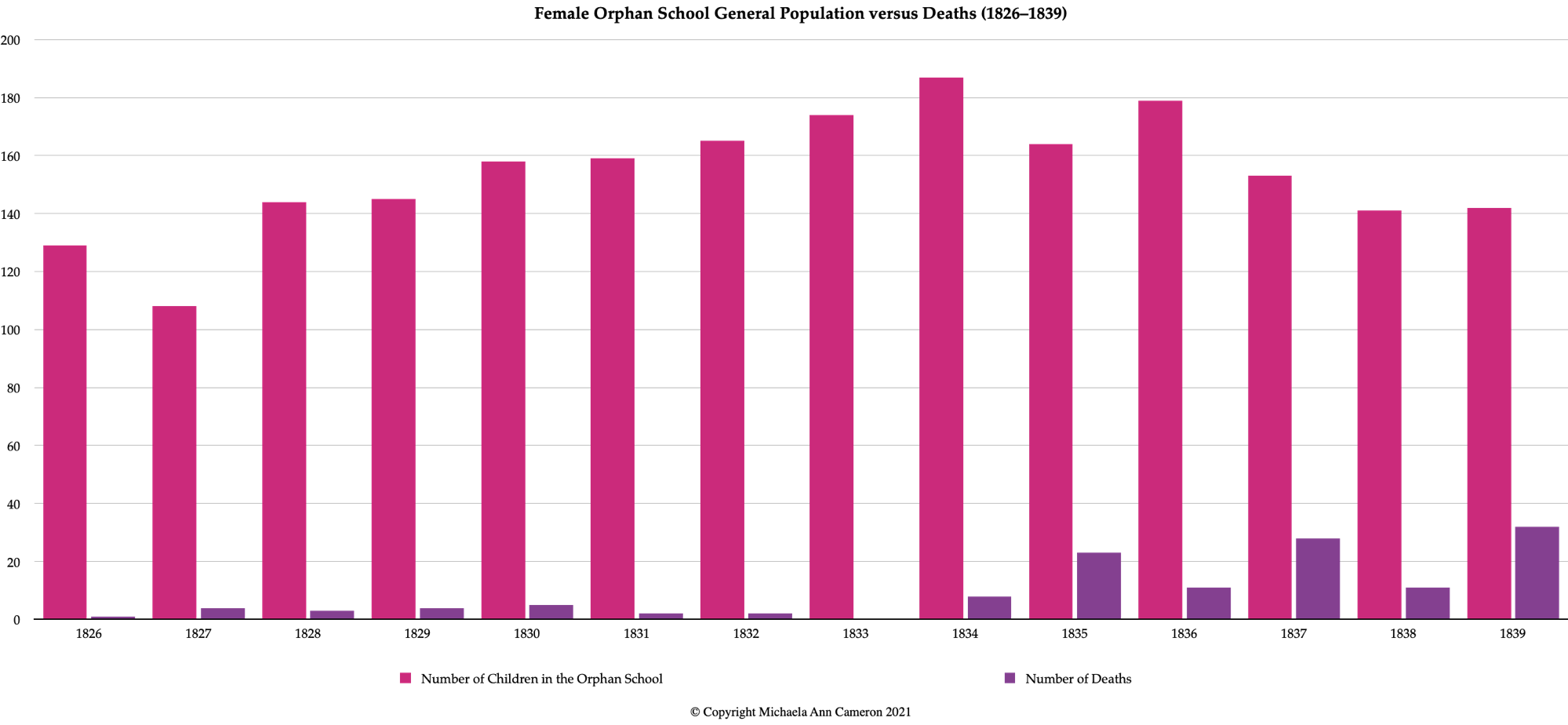
Viewing these two sets of data side by side reveals how significant a percentage of the student body was swiftly lost, not to mention the long-term effects these mass deaths must have had on the survivors as well as the staff who were tasked with caring for the sick and dying children. For what was clearly the Female Orphan School’s worst year on record at St. John’s, for example, 30 children were lost in the first six months of the year 1839, and another two would pass away before the year was over: that is 18% of the entire 1839 student population of 142 students. In addition, that annus horribilis was evidently not exceptional but one of a number of anni horribiles, as the Female Orphan School had suffered similar devastating losses in its very recent past: 1835 had seen 23 deaths there, while another 28 were logged in 1837. Given how close together those dreadful years were, many of the same children and staff would have been at the institution throughout the entire period concerned, and would have experienced those losses consecutively. Using the general population statistics to delineate a ‘sample’ period, 6% of all students who were enrolled as pupils at the Female Orphan School between 1826 and 1839 would prove to be among the ‘forever young,’ for they would not survive the institution.
As powerful as the statistics are, all 145 of the Female Orphan School’s lost children were much more than mere numbers; yet, like their fictional counterparts at Lowood, with only one notable exception (Eleanor Jane Simons, who joined a sister who predeceased her in a marked grave), all were interred in unmarked graves.[11] The lack of memorialisation of the destitute and orphaned children of colonial New South Wales, some of whom were the so-called ‘base born’ or legally ‘illegitimate’ children of prisoners incarcerated at the Parramatta Female Factory, certainly plays into a grim and oppressively sad Brontëesque or Dickensian impression of such institutions for children in the nineteenth century. But does the absence of any memorialisation over St. John’s Cemetery’s orphan graves really mean that few mourned the loss of colonial Parramatta’s disadvantaged children? That at the time of their premature passing their low social status as ‘base born,’ orphaned, confiscated, neglected and otherwise abandoned children effectively rendered them ‘ungrievable’ like the forever-young Helen of Brontë’s imagination?
The limited media coverage of colonial orphan deaths in general may add further credence to the notion that Parramatta’s disadvantaged children were deemed ‘no loss’ to their community. Of particular note is the apparent non-existence of any news reports of the high percentage of Orphan School deaths during epidemics. On closer inspection, however, it seems this media blackout was probably less a case of a general indifference to disadvantaged children than the authorities’ inevitable desire to avoid public indignation generally and any accusations of wrongdoing towards children for whom they had a duty of care; mourning had to be private in those instances rather than publicly lamented or highlighted. The Female Orphan School, after all, had previously struggled with being understaffed in this period, at which time it was noted that the unsanitary conditions directly eventuating from that situation had resulted in various contagious, though not life threatening, ailments among its pupils, such as ophthalmia, which left untreated could have caused blindness.[12] It is not hard to see why information about high mortality rates—even when those deaths were due to an epidemic rather than direct mismanagement—might have been suppressed.

On the rare occasions when the media did report in depth and, emphatically, with immense pathos on the deaths of Orphan School children, they revealingly did so when the children in question died in tragic accidents in private homes of the colonial elite; that is, when they were already out of the Orphan School and their untimely ends could not in any way reflect badly on the institution or, for that matter, on their masters and mistresses. Fifteen-year-old Elizabeth Coleson, for example, burnt to death in the home of Reverend Carvosso.[13] The newspaper report remarking with pity about how she came to her death is the only lasting testament to her community’s sadness at her passing.[14] For, even though her life was clearly considered publicly ‘grievable’ enough to warrant reporting her horrific end, there were of course practical obstructions to marking the death of this disadvantaged child.
The visible markers of grief in the nineteenth century came at a price, as demonstrated in the tally of funds Parramattans raised for the funeral of their celebrated convict constable Benjamin Ratty, who died heroically in the line of duty in October 1826.[15] The total expense for his funeral was over £26 and saw him furnished with an elaborately inscribed headstone relaying his heroism and a matching footstone, painted palisading, a coffin, and refreshments for mourners, as well as a suit of mourning for his convict widow, Ann.[16] In the the first half of the nineteenth century, publications at ‘Home’ in England indicated that female mourners ideally wore their grief in black ‘widows weeds’ of ‘full mourning’ for a period of time, then changed to ‘half-mourning’ clothing of more subdued colours, such as grey, purple, lilac and white to help transition to regular, brighter clothes.[17] For obvious reasons, sartorial articulations of grief were the privilege of the wealthy, or at least those who were handy enough to adapt existing wardrobe items by changing hemlines and dying the fabric. It stands to reason, then, that if the surviving relations of orphan children had possessed the means for mourning garb or stone memorials, then the children would never have been admitted to the orphan institutions in the first place. Thus, it is a simple fact that the low socio-economic status of the children at the time of their demise did prohibit grief from being materialised in ways it did not for those who were higher up the social hierarchy.


Yet a study of early nineteenth-century mourning customs highlights other mitigating factors to displays of grief which cut across all socio-economic strata: there were guidelines for the duration of mourning, determined by the relationship of the mourner to the deceased, as well as by the perceived social value of the individual based on their age at death. By the latter reasoning, the very elderly and the very young, regardless of their class, were supposed to be mourned for the least amount of time, having in the former exhausted, and in the latter not yet realised their value to society. Indeed, the St. John’s parish register strongly supports this, since with only a few exceptions even the well-to-do members of Parramatta’s population tended not to erect lasting memorials to infants and very young children.[18] It is not hard to see in such a context how the typically very young destitute and orphan children who died at the colonial orphanages might have been, by our modern standards, inadequately mourned, not simply because of their socio-economic status or even their lack of close ties in many cases, but also because of their sheer infancy. Under Macquarie’s governorship, children were to be admitted to the Orphan Schools between the ages of five and twelve, but in practice, as the statistics for St. John’s Orphans plainly reveal, they were often admitted far younger (especially if they were born in the Female Factory), and in 1825 the ages were officially extended to allow children under five.[19] Thus, even among the lower echelon of colonial society, there was further differentiation between those who were deemed worthy of tangible markers of grief, regardless of the prohibitive costs, and those who were not. Constable Ratty had been in the prime of his life, serving his community, and would have gone on to do the same for some time had his life not been cut short, thereby qualifying him for a community-funded funeral, but most of the children who died in our colonial orphanages had not had a chance to grow up and prove their value to their community, and were that much less ‘grievable’ because of it.
In light of all this, the case of seventeen-year-old Elizabeth Lees presents an interesting anomaly. She died while she was enrolled at the Female Orphan School, well above the age of most young girls at the institution, (probably having been internally apprenticed to the School), and was buried at St. John’s Cemetery, Parramatta, two months before one of our main exemplars Benjamin Ratty was laid to rest with pomp, ceremony, and all the trappings of a ‘proper’ funeral.[20] Elizabeth lacked the enduring, material markers of grief that Ratty was afforded, and even the detailed media accounts of her death that the Sunday School girl Lucy Broadbear and the recently-assigned Orphan School pupil Elizabeth Coleson attracted.[21] But what we do find in Elizabeth Lees’s case is a rare record of an unexpectedly elegant and grand performance of public mourning, in which the author of the account himself confirms our suspicions about the generally ‘ungrievable’ nature of Orphan Institution deaths by explicitly admitting that the ‘funeral obsequies’ surrounding Lees’s passing were anything but regular.[22]
Resurgam

For fifteen years, the corporeal remains of the fictional Helen Burns lay in a grave in Brocklebridge churchyard, ‘only covered by a grassy mound,’ until Jane Eyre, presumably, ensured ‘a grey marble tablet’ was erected to mark the spot, ‘inscribed with her name, and the word “Resurgam” [Latin: I shall rise again].[23] In the penal colony, few orphans could have drastically changed their own fortunes to be able to play the Jane Eyre and raise the funds to mark their fellow orphans’ resting places. And for any family history researchers hoping to at the very least visit the unmarked plot containing the remains of a relative they know perished at one of the local orphan institutions, the news is even bleaker. The green grave mounds of St. John’s Orphans are now eternally indivisible from the rest of the cemetery, the burial plot map having been long since lost. Thus, St. John’s orphans remain arrested in the ‘social oblivion’ that was the ‘prescribed condition’ of society’s less fortunate ones.[24] Only at All Saints Cemetery, North Parramatta, Burramattagal Country, have orphans from a later period been remembered in a memorial wall erected in 2004.[25] Perhaps in time we, like modern-day Eyres, more appreciative of the grievability of all lives, regardless of race, class, gender, age, creed, mental state, and so on, may rescue our real-life Helens from oblivion, by seeing to it that St. John’s Orphans ‘rise again’ with a memorial bearing each of their names, too. Till such time, this digital memorial must suffice.
CITE THIS
Michaela Ann Cameron, “Grievable Lives,” St. John’s Online, (2021), https://stjohnsonline.org/essay/st-johns-orphans, accessed [insert current date]
References
- Caitlin Adams, “Lives Left Behind: The Forsaken Families of First Fleeters,” St. John’s Online, (2019), https://stjohnsonline.org/bio/james-ogden, accessed 19 March 2021.
- Michael Belcher, [PhD Diss.], “The Child in New South Wales Society: 1820 to 1837,” (Armidale: University of New England, 1982).
- Charlotte Brontë, Jane Eyre, (London: Penguin, 1996).
- Beryl M. Bubacz, [PhD Diss.], “The Female and Male Orphan Schools in New South Wales, 1801–1850,” (Sydney: University of Sydney, Faculty of Education and Social Work, 2007).
- William Westbrooke Burton, The State of Religion and Education in New South Wales, (London: J. Cross and Simpkin and Marshall, 1840).
- Judith Butler, Precarious Life: The Powers of Mourning and Violence, (London and New York: Verso, 2006).
- Michaela Ann Cameron, “Elizabeth Lees: Departed Innocence,” St. John’s Online, (2021), https://stjohnsonline.org/bio/elizabeth-lees, accessed 19 March 2021.
- Alexander Cameron-Smith, “The Indifferent Characters of Many of the Females”: Mary Leeche and Colonial Controversy in the 1830s,” https://stjohnsonline.org/bio/mary-leeche, accessed 19 March 2021.
- Joy Damousi, “‘Wretchedness and Vice’: The ‘Orphan’ and the Colonial Imagination,” in Joy Damousi, Depraved and Disorderly: Female Convicts, Sexuality and Gender in Colonial Australia, (Cambridge: Cambridge University Press, 2004).
- Judith Dunn, The Parramatta Cemeteries: All Saints & Wesleyan, (Parramatta: Parramatta and District Historical Society, 2007).
- Jane Austen Centre, “Regency Mourning: An In-Depth Look,” Jane Austen Centre, (10 July 2012), https://janeausten.co.uk/blogs/womens-regency-fashion-articles/regency-mourning-an-in-depth-look, accessed 19 March 2021.
- Parish Burial Registers, Textual Records, St. John’s Anglican Church, New South Wales, Australia.
- Cornelia D. J. Pearsall, “Burying Bertha: Race and the Ungraveable Body in Jane Eyre,” in Justine Pizzo and Eleanor Houghton (eds.), Charlotte Brontë, Embodiment and the Material World, (Cham, Switzerland: Palgrave Macmillan, 2020), pp. 28–48 via, English Language and Literature: Faculty Publications, Smith College, Northampton, MA.
- The Whitlam Institute, Female Orphan School, Female Orphan School website text with footnotes, (Rydalmere: Western Sydney University, n.d.), accessed 19 March 2021.
NOTES
[1] Charlotte Brontë, Jane Eyre, (London: Penguin, 1996), pp. 95–6.
[2] Charlotte Brontë, Jane Eyre, (London: Penguin, 1996), pp. 94, 266.
[3] Charlotte Brontë, Jane Eyre, (London: Penguin, 1996), p. 96.
[4] Judith Butler, Precarious Life: The Powers of Mourning and Violence, (London and New York: Verso, 2006), p. 20 cited in Cornelia D. J. Pearsall, “Burying Bertha: Race and the Ungraveable Body in Jane Eyre,” in Justine Pizzo and Eleanor Houghton (eds.), Charlotte Brontë, Embodiment and the Material World, (Cham, Switzerland: Palgrave Macmillan, 2020), p. 30, via English Language and Literature: Faculty Publications, Smith College, Northampton, MA.
[5] Charlotte Brontë, Jane Eyre, (London: Penguin, 1996), p. 89; Cornelia D. J. Pearsall, “Burying Bertha: Race and the Ungraveable Body in Jane Eyre,” (2020), p. 28, English Language and Literature: Faculty Publications, Smith College, Northampton, MA.
[6] Caitlin Adams, “Lives Left Behind: The Forsaken Families of First Fleeters,” St. John’s Online, (2019), https://stjohnsonline.org/bio/james-ogden, accessed 19 March 2021. You can see the primary evidence of John Pounds’s entry to the School and the date and cause of his death in New South Wales Government, Special Bundles, 1794–1825, Series: NRS 898; Reels: 6020–6040, 6070; Fiche: 3260–3312, Pages: 1–2, (State Records Authority of New South Wales, Kingswood, New South Wales, Australia). I mention John Pounds in Michaela Ann Cameron, “Elizabeth Lees: Departed Innocence,” St. John’s Online, (2021), https://stjohnsonline.org/bio/elizabeth-lees, accessed 19 March 2021. New South Wales Government, Applications for Admission into the Orphan Schools, Series: NRS 782; Item: [4/331]; Roll: 2776; Page: 31, (State Records Authority of New South Wales, Kingswood, New South Wales, Australia).
[7] “Classified Advertising,” The Sydney Gazette and New South Wales Advertiser (NSW : 1803 – 1842), Monday 16 June 1828, p. 3; New South Wales Government, Applications for Admission into the Orphan Schools, Series: NRS 793; Item: [4/350]; Roll: 2777; Page: 6 (State Archives of New South Wales, Kingswood, New South Wales, Australia); New South Wales Government, Applications for Admission into the Orphan Schools, Series: NRS 793; Item: [4/351]; Roll: 2777; Page: 14 (State Archives of New South Wales, Kingswood, New South Wales, Australia);
[8] Parish Burial Registers, Textual Records, St. John’s Anglican Church, New South Wales, Australia.
[9] Parish Burial Registers, Textual Records, St. John’s Anglican Church, New South Wales, Australia.
[10] See Whitlam Institute, Female Orphan School, Female Orphan School website text with footnotes, (Rydalmere: Western Sydney University, n.d.), p. 11, https://www.westernsydney.edu.au/__data/assets/pdf_file/0007/926188/FOS_Website_text_with_footnotes_UPDATED_19_Aug_15.pdf, accessed 19 March 2021. For more on the measles that were said to be causing many deaths, both among infants and adults and among Europeans and non-Europeans in the colony shortly before the first major Female Orphan School “spike” in deaths, see “Filthiness and Indecency,” The Sydney Times (NSW : 1834 – 1838), Tuesday 13 January 1835, p. 2; “The Faculty. Measles or Not Measles,” The Sydney Times (NSW : 1834 – 1838), Tuesday 13 January 1835, p. 3; “Coroner’s Inquest,” The Alfred (Sydney, NSW : 1835), Tuesday 20 January 1835, p. 3; “Measles,” The Colonist (Sydney, NSW : 1835 – 1840), Thursday 22 January 1835, p. 3; “Death,” The Sydney Herald (NSW : 1831 – 1842), Thursday 26 February 1835, p. 3; “Deaths,” The Sydney Herald (NSW : 1831 – 1842), Thursday 10 September 1835, p. 3 and “Mission to the Aborigines,” The Sydney Herald (NSW : 1831 – 1842), Monday 18 July 1836, p. 4; Alexander Cameron-Smith, ““The Indifferent Characters of Many of the Females”: Mary Leeche and Colonial Controversy in the 1830s,” https://stjohnsonline.org/bio/mary-leeche, accessed 19 March 2021.
[11] For statistics of the Female Orphan School’s student population see William Westbrooke Burton, The State of Religion and Education in New South Wales, (London: J. Cross and Simpkin and Marshall, 1840), pp. 101, 190, 406. Note that his ‘death’ statistics for the years 1835 to 1838 proved to be incorrect when compared to the clearly marked ‘Female Orphan School / Institution’ burials in the St. John’s burial register. See Parish Burial Registers, Textual Records, St. John’s Anglican Church, New South Wales, Australia. For details of the marked grave that contains the mortal remains of three Simons sisters, Mary Ann (1828–1832), Eleanor Jane (1832–1839) and Lucy Viena (1827–1841), see Judith Dunn, The Parramatta Cemeteries: St. John’s (Parramatta, NSW: Parramatta and District Historical Society, 1991), p. 56. ‘Lucy Viena’ appears to have been the namesake of Lucy Vienna Broadbear, a local child who had died from horrific burns, aged only 11; interestingly, but perhaps only coincidentally, Lucy Vienna Broadbear’s mother Mary Broadbear actually worked at the Female Orphan School, and both of them are buried in St. John’s, Parramatta as well, although only Mary Broadbear has a marked grave. It is also noteworthy that Mary Ann Simons died, aged four, on 29 June 1832, just a couple of weeks after Eleanor Jane Simons’s 10 June 1832 baptism at St. John’s, Parramatta.
[12] Beryl M. Bubacz, [PhD Diss.], “The Female and Male Orphan Schools in New South Wales, 1801–1850,” (Sydney: University of Sydney, Faculty of Education and Social Work, 2007), pp. 243–4. The eye condition occurred in January 1826, even after many improvements had been implemented, demonstrating that the health of the girls continued to be a struggle at the Female Orphan School; Joy Damousi, “‘Wretchedness and Vice’: The ‘Orphan’ and the Colonial Imagination,” in Joy Damousi, Depraved and Disorderly: Female Convicts, Sexuality and Gender in Colonial Australia, (Cambridge: Cambridge University Press, 2004), p. 143; Michael Belcher, [PhD Diss.], “The Child in New South Wales Society: 1820 to 1837,” (Armidale: University of New England, 1982), pp. 91–2.
[13] “The family of the Reverend Mr. Carvosso…,” The Sydney Gazette and New South Wales Advertiser (NSW : 1803 – 1842), Thursday 9 September 1824, p. 2.
[14] “The family of the Reverend Mr. Carvosso…,” The Sydney Gazette and New South Wales Advertiser (NSW : 1803 – 1842), Thursday 9 September 1824, p. 2; “Burial of ELIZABETH COLESON, 1 September 1824, Age: 15 years; Burned to Death,” Parish Burial Registers, Textual Records, St. John’s Anglican Church, New South Wales, Australia.
[15] “[FROM A PARRAMATTA CORRESPONDENT],” The Sydney Gazette and New South Wales Advertiser (NSW : 1803 – 1842), Saturday 14 October 1826, p. 3; “No title,” The Sydney Gazette and New South Wales Advertiser (NSW : 1803 – 1842), Wednesday 13 December 1826, p. 3. See also Michaela Ann Cameron, “Benjamin Ratty: Convict Constable,” St. John’s Online, (2019), https://stjohnsonline.org/bio/benjamin-ratty, accessed 19 March 2021.
[16] “[FROM A PARRAMATTA CORRESPONDENT],” The Sydney Gazette and New South Wales Advertiser (NSW : 1803 – 1842), Saturday 14 October 1826, p. 3; “No title,” The Sydney Gazette and New South Wales Advertiser (NSW : 1803 – 1842), Wednesday 13 December 1826, p. 3. See also Michaela Ann Cameron, “Benjamin Ratty: Convict Constable,” St. John’s Online, (2019), https://stjohnsonline.org/bio/benjamin-ratty, accessed 19 March 2021.
[17] Jane Austen Centre, “Regency Mourning: An In-Depth Look,” Jane Austen Centre, (10 July 2012), https://janeausten.co.uk/blogs/womens-regency-fashion-articles/regency-mourning-an-in-depth-look, accessed 19 March 2021.
[18] Jane Austen Centre, “Regency Mourning: An In-Depth Look,” Jane Austen Centre, (10 July 2012), https://janeausten.co.uk/blogs/womens-regency-fashion-articles/regency-mourning-an-in-depth-look, accessed 19 March 2021.
[19] Beryl M. Bubacz, [PhD Diss.], “The Female and Male Orphan Schools in New South Wales, 1801–1850,” (Sydney: University of Sydney, Faculty of Education and Social Work, 2007), p. 38.
[20] “Burial of ELIZABETH LEES, 12 July 1826; Free; Orphan School,” Parish Burial Registers, Textual Records, St. John’s Anglican Church, Parramatta, New South Wales, Australia. See also Michaela Ann Cameron, “Elizabeth Lees: Departed Innocence,” St. John’s Online, (2020), https://stjohnsonline.org/bio/elizabeth-lees, accessed 19 March 2021; Michaela Ann Cameron, “Benjamin Ratty: Convict Constable,” St. John’s Online, (2019), https://stjohnsonline.org/bio/benjamin-ratty, accessed 19 March 2021.
[21] For more on Lucy Broadbear, see Michaela Ann Cameron, “Elizabeth Lees: Departed Innocence,” St. John’s Online, (2020), https://stjohnsonline.org/bio/elizabeth-lees, accessed 19 March 2021.
[22] “The funeral obsequies…,” The Australian (Sydney, NSW : 1824 – 1848), Saturday 15 July 1826, p. 3.
[23] Charlotte Brontë, Jane Eyre, (London: Penguin, 1996), p. 96.
[24] For the ‘social oblivion’ quotation see Cornelia D. J. Pearsall, “Burying Bertha: Race and the Ungraveable Body in Jane Eyre,” in Justine Pizzo and Eleanor Houghton (eds.), Charlotte Brontë, Embodiment and the Material World, (Cham, Switzerland: Palgrave Macmillan, 2020), p. 28 via, English Language and Literature: Faculty Publications, Smith College, Northampton, MA.
[25] Judith Dunn, The Parramatta Cemeteries: All Saints & Wesleyan, (Parramatta: Parramatta and District Historical Society, 2007), pp. 35–56.
© Copyright Michaela Ann Cameron 2016–2021
 St. John's